


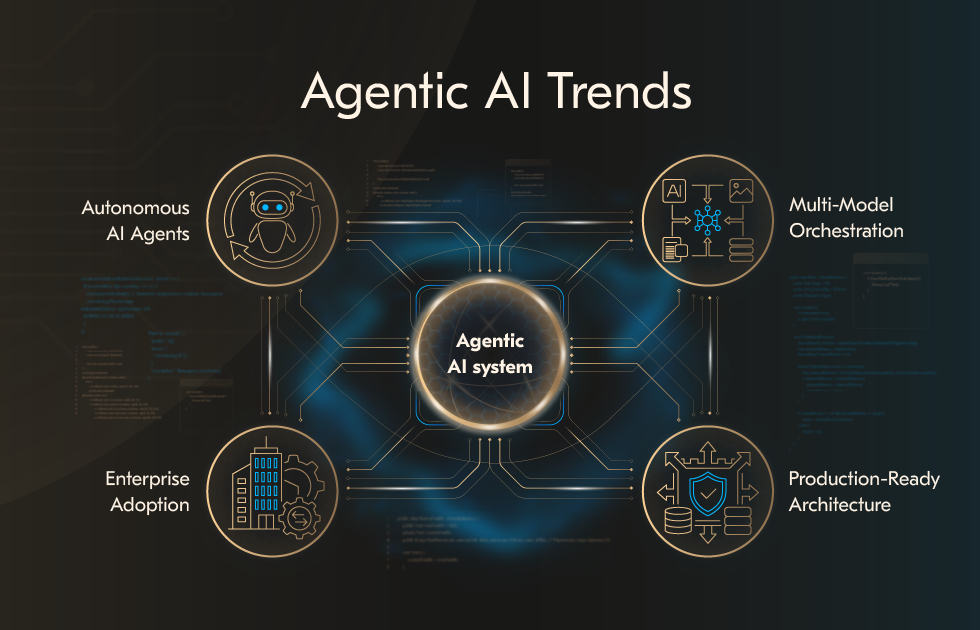
Artificial intelligence is moving fast, but not all AI is evolving at the same pace. While many enterprises are still optimizing generative tools, a new wave of innovation is emerging through agentic AI solutions. These systems do not just generate outputs. They analyze goals, make decisions, execute tasks, and refine strategies autonomously.
If you are leading digital transformation in the United States, understanding where this technology is heading over the next five years will help you make smarter investment decisions today.
The Shift from Assistive AI to Autonomous AI
Over the past few years, AI has mostly acted as an assistant. It drafts emails, summarizes reports, and generates ideas.
In the next five years, we will see a strong shift toward autonomy. Agentic AI services & solutions will increasingly handle end to end workflows without constant human prompts. Instead of assisting managers, AI agents will manage defined operational goals independently.
Industry analysts predict that by 2030, more than 50 percent of enterprise workflows will include some level of autonomous AI orchestration.
Deeper Integration Across Enterprise Systems
Today, many AI tools operate in silos. Over the next five years, integration will become a priority.
Agentic AI solutions for enterprises will connect seamlessly with CRM platforms, ERP systems, supply chain tools, and analytics environments. These integrations will allow AI agents to execute decisions directly within operational systems rather than simply recommending actions.
For your organization, this means faster execution cycles and fewer manual handoffs between departments.
Real Time Decision Intelligence at Scale
Data volumes are growing exponentially. US enterprises generate terabytes of operational data daily. The next wave of agentic AI data solutions will focus on real time analysis and action.
Instead of reviewing weekly performance reports, AI agents will adjust strategies instantly. Marketing budgets, pricing strategies, and resource allocations will adapt dynamically based on live data streams.
This level of responsiveness could improve operational efficiency by 30 percent or more in data intensive industries.
Expansion into Mid Market Enterprises
Currently, large enterprises lead adoption due to higher budgets and advanced data infrastructure. Over the next five years, adoption will expand rapidly into mid sized organizations.
As platforms become more accessible and cloud based AI services mature, scalable AI Services and AI Solutions will become affordable for a broader range of businesses.
This democratization of autonomy will intensify competition, especially in highly competitive US markets.
Stronger Governance and Ethical Frameworks
With greater autonomy comes greater responsibility. Regulatory frameworks and corporate governance standards will evolve alongside agentic AI adoption.
Expect more emphasis on transparency, auditability, and explainability. Enterprises will invest in monitoring tools that track AI decisions and ensure compliance with industry regulations.
Organizations that prioritize governance early will build stronger stakeholder trust and avoid regulatory risks.
Human and AI Collaboration Models
Despite growing autonomy, human oversight will remain essential. The future is not about replacing leadership teams but enhancing their capabilities.
In the coming years, we will see hybrid decision models where AI agents manage operational execution while humans focus on strategic direction and innovation.
Companies that foster collaboration between employees and agentic AI solutions are likely to see higher productivity and stronger employee satisfaction.
Vertical Specific AI Agents
Another major trend is specialization. Instead of generic AI systems, we will see vertical focused agents tailored for industries such as healthcare, finance, manufacturing, and retail.
These specialized agentic AI data solutions will incorporate domain knowledge, regulatory requirements, and industry best practices into their reasoning models.
For example, financial sector AI agents will integrate compliance logic automatically, while healthcare agents will prioritize patient safety protocols.
Increased Focus on ROI Measurement
In the early stages, enterprises often adopted AI for innovation branding. Over the next five years, measurable ROI will become the primary driver.
Businesses will demand clear metrics such as cost reduction percentages, productivity improvements, and revenue growth directly linked to autonomous AI initiatives.
Studies already show that companies deploying intelligent automation effectively report ROI within 12 to 18 months in high impact use cases.
Rise of Multi Agent Ecosystems
Today, many organizations experiment with single AI agents. The future will involve ecosystems of coordinated agents working together.
One agent may handle customer engagement. Another may manage supply chain optimization. A third may oversee financial risk. Together, they will coordinate actions across enterprise systems.
This multi agent architecture will create highly adaptive and interconnected business environments.
Competitive Differentiation Through Speed
In the next five years, speed will become the defining advantage. Enterprises that adopt advanced agentic AI solutions for enterprises early will operate faster, respond quicker to market changes, and innovate more efficiently.
Late adopters may struggle to keep pace as competitors leverage real time intelligence and autonomous execution to capture market share.
Preparing for the Next Phase
If you want to stay ahead, begin preparing now. Invest in data infrastructure. Build cross functional AI teams. Develop governance frameworks.
The organizations that treat agentic AI services & solutions as a strategic transformation rather than a short term experiment will lead their industries over the next decade.
Conclusion
The next five years will redefine how enterprises operate. Agentic AI solutions will move from experimental pilots to core operational engines driving intelligent automation, real time decision making, and cross functional coordination.
For US businesses seeking sustainable growth and competitive leadership, investing in scalable and governed agentic AI data solutions today positions your organization for long term success in an increasingly autonomous future.
